Trastevere quarter
|
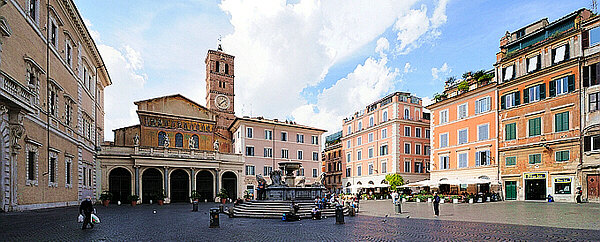
Santa Maria in Trastevere church and square |
The name "Trastevere" derives
from Latin "Trans Tiber" (across the Tiber).
During the ancient Roman period it was a green neighbourhood belonging
to noble families, including that of Julius Caesar. Cleopatra is
thought to have lived here. In that epoch it was still encircles by the walls, and the
gates were Porta Portese and Porta San Pancrazio.
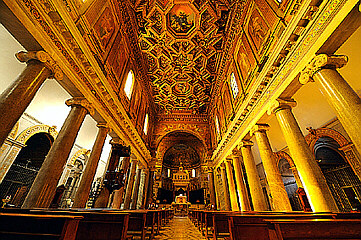
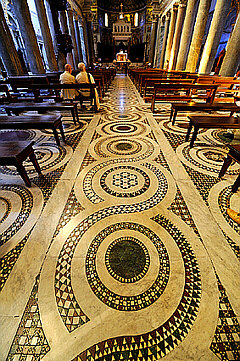
Top: the interior of the Church
Right: the magnificent medieval pavement of the Church
|
|
|
APARTMENTS FOR RENT NEAR THIS
AREA
"TRASTEVERE SWEET HOME": a bright, silent double bedroom apartment with terrace, ample sitting room, remarkably equipped. Elevator. Wheelchair friendly.
"ROMAN ROOFS" : a one bedroom top floor apt. with ample sitting-dining room, patio and panoramic terrace overlooking old Rome's roofs and sights.
"CARAVAGGIO", an elegant designer one bedroom apartment, tastefully and skillfully prepared and remarkably equipped (up to 4 persons).
"MARCO POLO", a one bedroom, sitting room attic with large roof garden with spectacular views of all Rome (2-3 persons). Elevator
"BOTTICELLI": elegant 2 double bedroom, sitting room, dining room 2 bathroom apt., with patio and fireplace (4-5 persons). Elevator.
"ROME DOMES": Fine 2 bedrooms 2 bathr. attic, with sitting room, dining room, large open plan kitchen, with 2 utmost panoramic terraces with views of Rome's domes, in an elegant historical palace facing the famous Tortoise fountain. Daily cleaning (4-5 persons). Elevator.
"TORTOISES": Finest 3 bedroom 3 bathroom apartment with sitting room, dining room, large terrace with views, in an elegant historical palace facing the famous Tortoise fountain. Excellent fittings and equipment. Daily cleaning. (3-6 persons). Elevator. |
After the fall of the Roman empire it became a quarter
of Jewish trading communities.
|
In the early Middle Ages the
Jews moved to the other side of the river (the quarter that
later became the Ghetto), and Trastevere became the main working-class
district of the capital. The inhabitants boast that their quarter
is "er core de Roma" (the heart of Rome, in Roman dialect).
Nowadays it is a picturesque and artistic quarter where the
so called "Roma sparita" (the 17th - 19th century
"disappeared Rome", with all its lively, authentic
relations embedded in human qualities and with a society still following a human pace)
is still somehow in the air and in everyone's memory. It leads to
a nostalgia that transformed into a culture on its own right, affecting whoever lives in Rome for some time, native or adoptive.
All streets seem to lead to the stunning Piazza di Santa Maria in Trastevere. The Church of Santa Maria in Trastevere (top) is
believed to be the most ancient one dedicated to the Virgin in Rome. Although
the first church was built on the site in the 3rd Century, the present
structure was built in the 12th century according to the Romanic architectural
style. The interior decorations are instead of the much later baroque period.
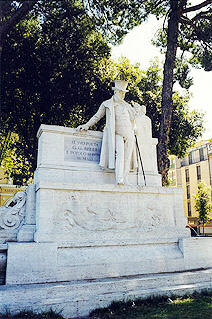
Left: Poet G. Belli statue
|
The quarter includes countless craftsmen shops, art shops
and art-house cinemas. At times it seems that every ground-floor
space is a restaurant, a pizzeria, a "piano-bar", a bookshop
with attached a cozy bar. In July there is a characteristic popular
festival, much attended by tourists and Romans alike, called "Festa
de Noantri", which means in Roman dialect "Festival for
Ourselves".
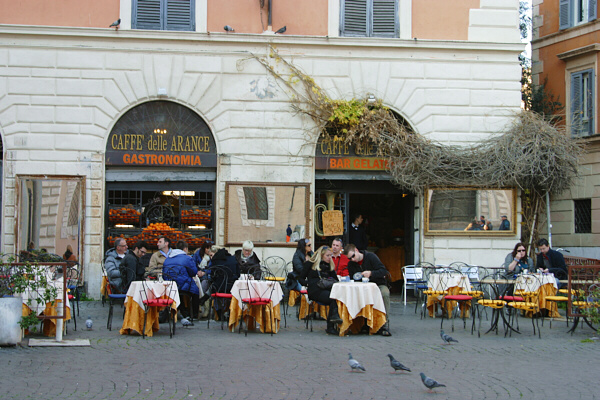 |
One of the numberless finest cafes / restaurants in the quarter: the Caffe' delle Arance (Oranges Cafe). |
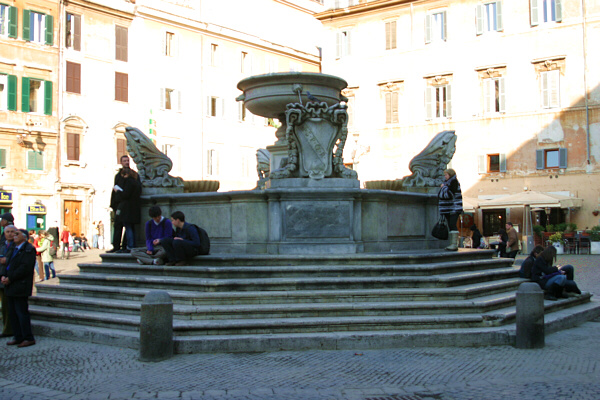
Top: the beautiful and large fountain in the centre of the Piazza Santa Maria in Trastevere
Right: The Church of Santa Maria della Scala |
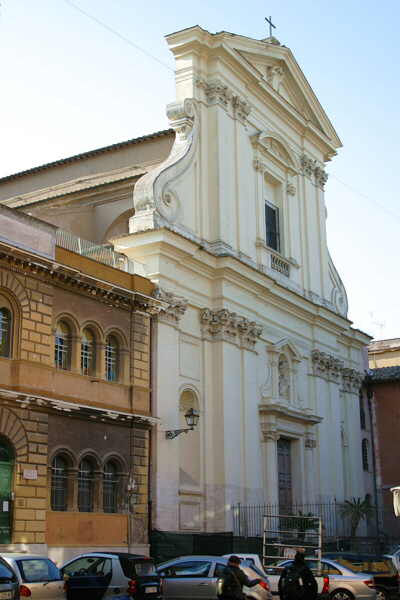 |
There are also beautiful churches, like Santa Maria della Scala
(top right), or Santa Cecilia.
During the two centuries before unification
(1870) there was a strong tradition of violent rivalry between
the "bulli trasteverini" (Trastevere toughs) and
the "monticiani" (the boys from Monti). The violent
clashes between gangs (an anticipation of West Side Story)
were narrated by poet Giuseppe Gioacchino Belli, whose statue as shown
now adorns Piazza Belli at the beginning of Viale Trastevere.
| |
Presently the quarter is very trendy, and is a desirable
place to live for artists and for many non Romans (Italian and also from the world over), who notably have not changed the intriguing densely-knit character of the quarter, but rather moved with the purpose of integrating in it, which is a rewarding experience. The price of housing is soring, yet the quarter kept its own character and culture.
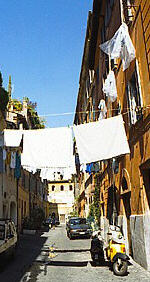
The boisterous character, the fun loving vulgarity and the good-humoured cynicism of the Trasteverini as described by Belli (which are regarded nowadays as typical Roman popular traits) are seemingly kept alive as a cheerful fashion just to impress. Nevertheless one can still find old ladies sitting outside just for the pleasure of watching passers-by while they do their laundry, or neighbours chatting to one-another from the windows etc.. The old spirit is still alive.
(Right): Vicolo del Cinque, Sunday cleaning
|
|
|
| |
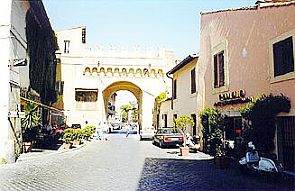
Porta Settimiana is the northern gate to the Vatican.
It continues with Via della Lungara, paved and widened by Pope Julius
II to mirror his Via Giulia on the other bank of the river. The
street has some of Rome's most splendid "palazzi", as Villa Farnesina with frescoes of Raphael, the Palazzo Corsini, and the adjacent beautiful Orto Botanico (Botanical Gardens). Just after there is Regina Coeli, the medieval prison of Rome, which is bound to be closed. |
|
| |
|
|
|
|
Porta Settimiana, the gate to the
Vatican
|
|
| |
|
|
| |
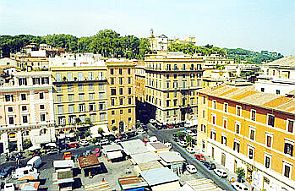
Above Trastevere you find the Gianicolo (Janiculum), and after it Monteverde
Vecchio - top left photo, showing also Piazza San Cosimato where
a vegetable and groceries morning market takes place. Despite being the highest hill of Rome, the Gianicolo is not considered one of the official seven
hills of Rome. It can be reached through the tortuous Via Garibaldi,
passing through the splendid baroque Fontana Paola. The view from
the Gianicolo is the most spectacular of Rome. The statue-dotted
gardens of the hill are dominated by the huge equestrian statue of
Giuseppe Garibaldi, close to which soldiers of the Italian Army fire a cannon every day at
noon to commemorate the battles of Rome's independence in 1848 against the invading French Army. |
|
| |
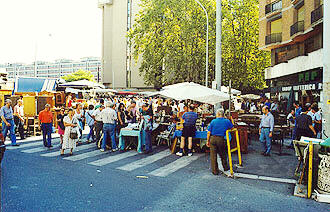
On the other side of Viale (Italian for Avenue) Trastevere
there is a very renowned and popular flea market. It is called Porta Portese, as its traditional main entrance is this ancient
Roman gate near the Tiber and to its ancient
port of Rome.
It originated as a black market during World War II, and it
became very popular just after. Perhaps the most interesting
section is the one with antiques, in Via Ippolito
Nievo and in a section of Piazzale della Radio. The market is open only on Sunday mornings (if it does not rain!), and the
best bargains are achieved either very early (around 7 AM), or very late, at closing
time around 1-1.30 PM.
(Right): Porta Portese flee market: the antique furniture
section |
|
|
|
| |
|
|
| |
Transportation
to the other quarters of the "centro storico" is excellent, especially by means of tram 8 running along Viale Trastevere. It is like
a subway actually, as it has own lanes, and it is very frequent, also with
many stops along the Viale. It arrives in a few minutes to Largo Argentina,
in the heart of the centre, at walking distance to any place or site of the centre. |
|
Visit also: The streets, the squares, the churches and the cheerful ambience of Trastevere

To visit the other quarters and sights, please go to: |
Visit Rome | Rome panoramic views | Rome apartments and villas | Inquire | Rome travel guide | Rome map | Service | Resources
Roman Homes homepage |