Rome Jewish Ghetto, the Roman Jews, and Jewish Rome
| In memory of Herbert Pagani: "By the light of friendship, the sky is more blue." (L'amitié - 1975). |
MUSIC:
Bashanah haba'ah
- Next year
(Jewish traditional song) |
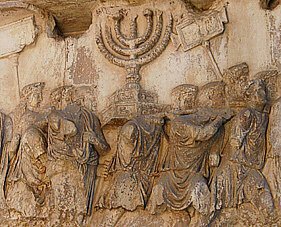
Arch of Titus: bas-relief showing the Roman legions carrying a Menorah and war booty from Judea.
Click here for a wider photo, and detailed story |
Rome's Jews are Europe's longest surviving Jewish community and occupy a unique place in the history of the Diaspora. Jews have been living in Rome, as well as in other Mediterranean cities, since the 3rd century BCE. Their homeland was overcrowded, and troubled with foreign occupations. As a result, Jews migrated to the other Mediterranean towns, where they formed communities.
The first recorded presence of Jews in Rome is of Maccabees embassadors seeking an alliance with the Roman Senate against the Syrian Greeks who desecrated Jerusalem's Temple. Because of the growing importance and prosperity of Rome, in time the Jewish population increased.
As opposed to the situation resulting from the Roman occupation of Judea, in Rome the Jews were generally tolerated, especially by the rulers. Julius Caesar was known to be their friend. |
Following emperor Titus' occupation of Judea and the destruction of the Temple of Jerusalem in 70 CE, the Jews were dispersed in the Roman empire. A part were enslaved as miners in Spain, a part were sold as slaves, and ransomed by the Roman Jews. Titus returned triumphant to Rome with the war booty, which funded the construction of the Coliseum.
|
|
APARTMENTS FOR RENT IN THIS AREA
"THE TURTLES' DREAM": wonderful four bedroom three bathrooms, amazing sitting room, separate large dining room / kitchen, terrace in historical palace facing the Turtle Fountain. Elevator (up to 8 guests).
New! Highly recommended.
"The TURTLES NEST": Finest four bedroom three bathroom apartment with sitting room, dining room, panoramic terrace / roof garden with stunning Rome views, BBQ and additional kitchen, in an elegant historical palace facing the famous Tortoise fountain. Excellent fittings and equipment. Elevator! (up to 8 guests).
New! Highly recommended.
"MARCO POLO", a one bedroom, sitting room attic with large roof garden with spectacular views of all Rome (2-3 guests). Elevator.
"CARAVAGGIO", an elegant designer one bedroom apartment, tastefully and skillfully prepared and remarkably equipped (up to 3 guests).
"BOTTICELLI": elegant 2 double bedroom, sitting room, dining room 2 bathroom apt., with patio and fireplace (4-5 persons). Elevator.
"ROME PANORAMA": Large elegant designer panoramic attic near Piazza Navona, with four bedrooms and four bathrooms. Two expansive panoramic terraces with 360 degree views of all Rome's sites. Elevator. Sitting room, separate dining room, fireplace. Unobtainable! (up to 8 guests).
"ROME DOMES": fine 2 bedroom 2 bathroom attic, with sitting room, dining room, large open plan kitchen, 2 utmost panoramic terraces with views of Rome's domes, in an elegant historical palace facing the famous Tortoise fountain. Daily cleaning (4-5 guests). Elevator.
"TORTOISES": Finest 3 bedroom 3 bathroom apartment with sitting room, dining room, large terrace with views, in an elegant historical palace facing the famous Tortoise fountain. Excellent fittings and equipment. Daily cleaning. (3-6 guests). Elevator. |
|
Initially persecuted like the Christians by the Roman establishment, when Christianity became the official religion of the empire, they were discriminated and persecuted by the Christians.
Nevertheless, for a long time, the capital of the Christian Church was a safe haven compared to the rest of Europe, although the Church imposed taxes on Roman Jews, the first dating back in 1310, officially for their protection from outbreaks of popular violence against them. Hardships followed as in the rest of Europe.
|
| |
The anti-Semitic Pope Paul IV in 1555 issued the infamous bull Cum Nimis Absurdum, taking its name from its first words "Since it is absurd" ("...and utterly inconvenient that the Jews, who through their own fault were condemned by God to eternal slavery…"). Under the accusation of having exploited the generosity and hospitality of the Christians, the bull practically reduced the Roman Jews to slavery.
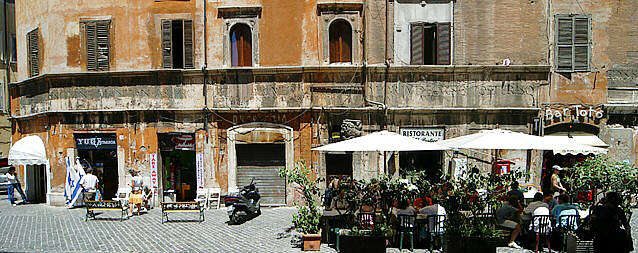
(Right): the heart of the quarter: Via Portico d'Ottavia |
|
The walls of the Ghetto (a word Venetian in origin) were built, separating the Jews from the rest of the society. They lost any property rights (they had to rent at high prices even their homes of the ghetto from Christian owners). They were only allowed to trade second hand objects, and they could not employ Christian personnel. Jewish medical doctors could not cure Christians, even if implored to do so. Outside the ghetto, they had to wear the "Jewish sign", to be easily recognized: men had to wear a yellow patch on hats, women wore a yellow kerchief (the sign of prostitutes). They could only live in a few towns of the Papal kingdom, and only one synagogue in each town was allowed.
| |
The street Via Portico d'Ottavia (Octavia's Porch street) is still the centre of Jewish life in Rome.
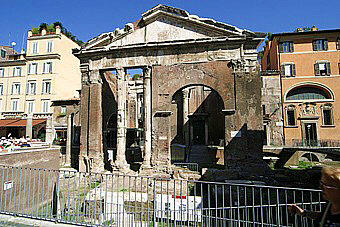
Initially built in 146 BCE, it was entirely renovated by Augustus, and dedicated to his sister Octavia.
It was a small forum in its own right, with Greek and Latin libraries, halls for music and public meetings, and with precious works of art.
Because of its proximity to the river, the area also hosted the fish market. Fish was a most desired food, and fishermen had to pay high rents to the noble families owning the stalls.
Nowadays the street is a lively hotchpotch of ancient, medieval and Renaissance architecture.
The facade of the porch is nearly intact, yet presently within its space you find a Catholic church.
(right): The Portico d'Ottavia (Octavia's Porch) |
|
|
The subsequent popes confirmed the restrictions, some times mitigating them (and thus also craftsmen, bankers, antique dealers and jewelers could practise), yet some popes also tighten them up (for ex. Jews found at night outside the Ghetto would be executed). The result was that the small Ghetto was crammed with nearly 4,000 Jews, in squalid conditions, where they were confined during night time. Most were restrained to work as ragmen or moneylenders.
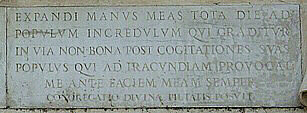
Moreover, oppression occurred in everyday life. The Jews were at times falsely accused of committing "ritual murders" of Christians, in particular of children. The false accusations were excuses for outbreaks of violence and of murders of Jews. On the other hand, whenever possible, Jewish children were forced to convert. The Jews were also periodically compelled to attend mass in Catholic churches, where they were lectured to convert, especially in the Church San Gregorio della Divina Pieta' (St. Gregory of Divine Mercy) also called San Gregorio ai Quattro Capi (St. Gregory of the Four Bridge Ends).
A marble slab in the facade of the church recalls the atmosphere of those years. In two languages (Hebrew and Latin), it engraves an offensive and threatening interpretation of Isaiah's prophecy (Chapter 65:2):
"I spread forth my hands all day to an unbelieving people, who walk in a way that is not good, after their own thoughts. A people that continually provoke me to anger before my face."
|
|
The Roman Jews are rightfully proud to have endured such incredibly long-lasting and infamous oppression, and the formidable pressures to convert. They are also proud folk in their own right.
When the unification of Italy occurred in 1870, the new Italian government ended the oppression and the discrimination carried on by Catholic Church, 315 years after the above mentioned bull of Pope Paul IV. The walls of the Ghetto were destroyed, and the Jews enjoyed equal rights. Consequently, they went through a process of emancipation, becoming a normal and likewise essential part of the Italian society. Many Jews also became nationalists, and at the onset of fascism, many endorsed it, or even became fascists themselves. This didn't spare them from the discriminatory 1938 "Racial Laws", in which all Jews lost their public jobs, positions, and rights to attend even schools, because of their alleged "race inferiority".
The experience left a lasting memory in the Italian Jews, arising reservations whether it is wise to integrate completely, or to be assimilated within the Italian society.
| |
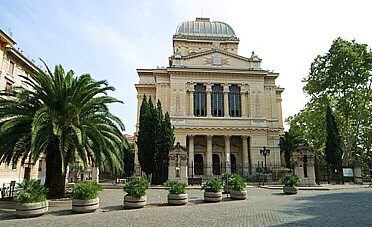
Rome main Synagogue
The Italian Jews follow their own rite (called Nusach Italki), as their presence occurred before the destruction of the second Temple in 70 CE. They are thus not Sephardi (Oriental or Arab countries Jews), nor Ashkenazi (Eastern Europan Jews). The Roman Jews are also called in Hebrew "Romanim".
The imposing main synagogue or Il Tempio (The Temple) was designed by the architects Armanni and Costa (1904 CE). It has a "neo-Assyrian-Babylonian" style, and it terminates in a large quadrangular aluminium dome.
The synagogue incorporates the Museo d'Arte Ebraica, a small museum of Roman Jewish life and ritual, which is very dear to the Roman Jews.
(Right): The main Synagogue, called Il Tempio or The Temple. |
|
|
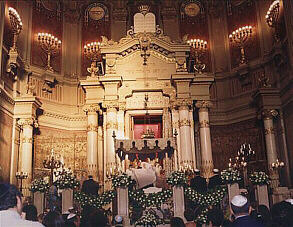
Interior of the main Synagogue, during a service
|
Rome Jewish-Catholic interaction, nowadays.
Formally the entrance of the synagogue is allowed to all, yet in fact it is very difficult to enter, especially during religious ceremonies. Officially explained as a safety measure, as precaution to the ever impending anti-Jewish terrorism, it is more effectively - despite denials - the result of the Roman Jews' convincement to have to defend their Jewish identity ("Zehut"), and thus their cultural diversity, which makes them discreetly and meticulously keep non-Jews at a distance.
To a lesser extent, it is also a reaction to the interfering pressure of the modern estate market, which causes the decrease of the Jewish population in the quarter.
Last but not least, some of the custodians of the temple ("Shammash") are rude and whimsical, and they might turn away even Jews with very flimsy excuses. Practically, only the guided tour of both the synagogue and the museum is possible, after ceremony hours (entrance 7.5 Euro).
|
On the other hand, while the
Catholic Church apologizes for the past wrongdoings, and asserts its good faith to respect Jews with rosy statements, the majority of the circles of the Church - despite denials, in their turn - have a self-righteous, prejudiced attitude towards them, subtly marginalizing them from all contexts.
Moreover, although the Catholic Church stopped interfering, the many churches planted in the heart of the area, built to supplant Judaism in Rome, can still be found there.
You can thus perceive that two civilizations intersect in the little quarter, and although nowadays they do it politely, they resemble two tectonic plates clashing, set on the opposite banks of the Tiber (the Vatican to the West, the Jewish quarter to the East). Outnumbered by all means, the little Roman Jewish community would appear to be no match, yet it endures with one of its noteworthy merits: tenacity. In the end, expect a defensive attitude when approaching Roman Jews.
Trade bridges the cultural divide between Jews and non-Jews. Many friendly non-Jewish owners run shops in the area, and Jews naturally welcome non-Jewish clients. This type of interaction breeds cordial relations, and perhaps it will make both sides cross the bridge one day.
Visit the pages on the Jewish ghetto restaurants and shops, |
In October 1943 the Nazi occupiers pretended 50kg of gold from the community, to be handed in 36 hours. Both Jews and non-Jews responded and the goal was reached, but the Nazis still deported over 2,000 Jews to Auschwitz. Only 16 survived and returned to Rome. One fourth of Rome's Jews died, yet the number would have been higher had it not been for the help of wide sections of the Roman society, including the Catholic priesthood.
Pope Pius XII though did not condemn the persecution, nor especially the last aggression, which was a highly controversial conduct. The Catholic Church maintains that it had to keep wisely neutral, and that standing against the crimes would have brought Nazi Germany to involve in the war with the allies the Church premises, leading to their destruction (as it occurred with the Montecassino Abbey). Moreover, the Church claims that condemning openly the persecution of the Jews would have led also to the persecution of the Christians, hampering the practical help given to the Jews from Christians and from many priests to escape the oppression.
The Jews however remember well though the prejudice of large circles of the Catholic establishment against them, and in fairness a consistent part of the Church had a liking for fascism as defender of traditional values. It is also acknowledged that two German diplomats in Rome, informed of the plans to exterminate the Jews, and risking their lives, went personally to the Vatican imploring the Church to take action, uneventfully. Whether it was a tactical political position under the circumstances, or an appeasement, or negligence, the Jews - and many others - believe in the end that the Catholic Church distanced from them.
In any event the Catholic Church did not take a position equal to the high ideals it announces, which would have been a reference in those days of gloom and doom. The open condemnation of the hideous crimes of the Nazis would have probably changed the course of the war, and it would have surely opened the way to a new era, standing as a landmark in world history.
Currently the Italian Jews practise all professions, and they contribute to the Italian culture also with many intellectuals. Most Italian Jews are quite happy to consider themselves Italian, and they are regarded by their compatriots as an essential part of the broader Italian society. Some Jews even apply Hebrew root words to the word Italia, deriving it from I Tal Yah - Island of the dew of God.
Only 4,000 Italian Jews migrated to Israel in the last 50 years (out of a community of 30,000 members). Most of them did it just after WW2, after the disastrous experience of the holocaust and to contribute to the foundation of Israel. Typically, another part - still a minority - moved later motivated by cultural / religious reasons. They usually stay in Jerusalem for its special religious appeal, and they generally have a good economic background (on the contrary of the majority of the Jews migrating to Israel).
A third and final group, again a small minority, comprises those who move temporarily to Israel. They generally have cultural and political motivations (to contribute to the Israeli society and to Zionism). In Israel they usually undergo professional experiences, or serve in the army, to support Israel.
Yet Roman Jews are mostly attached to Rome. "Next year in Jerusalem?" Yes, but only in prayers and in toasts: the large majority of Roman Jews plan to spend it in Rome... They are often scoffed at with affection by the other Jews as "the Pope's Jews", especially by the Israeli, who find them all too Italian.
|
|
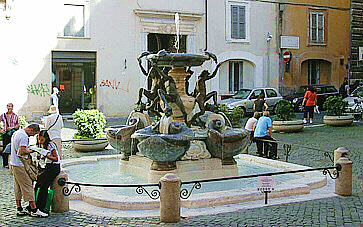
|
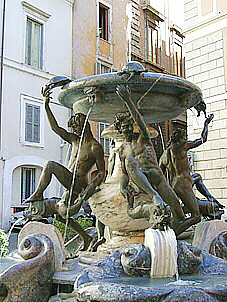
In the northern area of the Jewish quarter, you find the marvellous Turtle Fountain (Fontana delle Tartarughe), in the little square in front of the patrician Palazzo Mattei and Palazzo Costaguti (16th century) endowed in the interior with fine marbles, statues and decorations, and frescoes by Guercino, Domenichino, Cavalier D'Arpino, Gaspard Poussin and the Zuccari brothers.
The fountain was created (1581-1588) by the Florentine sculptor Taddeo Landini, following the design of Giacomo della Porta.
|
|
|
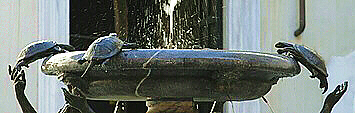
Four large marble conch shells stand on a quadrangular basin, upon which four ephebes (slender youth) stand with their foot on the head of bronze dolphins.
The ephebes raise their arms to help the turtles get in the basin. The turtles were placed only during a renovation occurred in 1658, and they replaced four other dolphins.
The bronze turtles are generally attributed to Bernini, although it is not certain. |
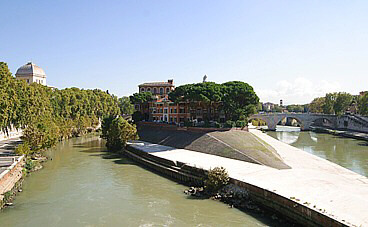
The quarter ends on one side with the Tiber, where the most ancient bridge in Rome, the Ponte Fabricius, leads to the little Tiberina Island.
The island includes the Catholic Basilica of St. Bartholomew, the Catholic hospital Fatebenefratelli, the Jewish hospital, and the Jewish review "Shalom".
Another bridge, the Sulpicius, leads to the Trastevere quarter (from the root words "Trans Tiber", beyond the Tiber).
The Jews settled initially in this quarter, and only in medieval times they settled on the other side of the Tiber, in the present location.
(Right) The Tiberina island, connected with the bridges Fabricius (left), to the Jewish quarter, and Sulpicius (right), to Trastevere. |
|
| |
|
|
|
|
|
| |
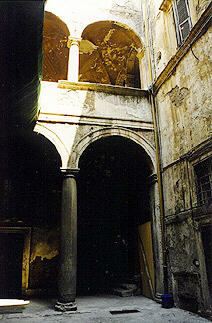
An old photo showing the degraded condition of the buildings during the epoch of the ghetto. Presently this palace, and many others, are instead entirely renovated. |
|
|
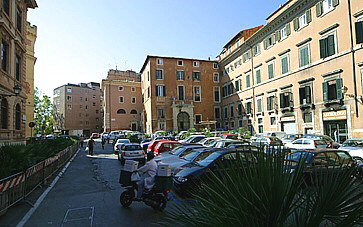
Piazza Cinque Scole is named after the five synagogues which existed in the square during the epoch of the ghetto. Passing off the synagogues as "schools" was a way to by-pass the Popes' restriction according to which every town could have only one synagogue. The square is quiet, elegant in contrast with the lively adjacent Via Portico d'Ottavia. |
|
Visit also:
Rome Jewish shops and restaurants
The Libyan Jews in Rome
Strolling in the neighboorhood
|