SAINT PETER IN CHAIN - SAN PIETRO IN VINCOLI
In the Monti quarter there are many churches, some of which are
universally famous. The Church of San Pietro in Vincoli (St. Peter's
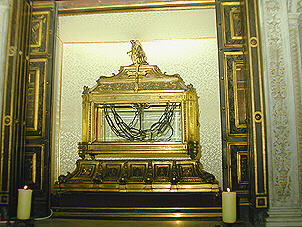
in Chains) owes its name to the precious relic it hosts: the chains
used to fetter St. Peter in his prisons in Jerusalem and in Rome.
The original church was dedicated to the Apostles and was built
in the 4th century. Cardinal Giuliano della Rovere, the future Julius
II, completely modified the church in the 15th century, which was
further modified during the next century.
|
|
San Pietro in Vincoli,
exterior
|
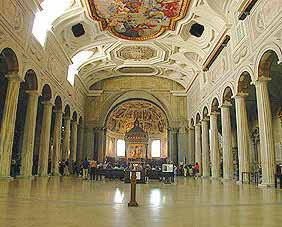
The church: interior |
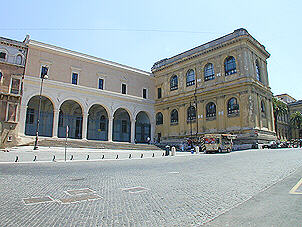
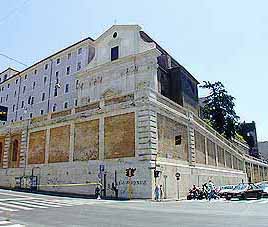
In the top left photo you can see the exterior of the church, with a portico of five
arches, adjoining to the building of the faculty of engineering to its right.
The church has the layout of a much larger basilica, as it is divided by twenty ancient
marble columns in the interior.
On the ceiling you find a beautiful fresco by Giovanni Battista
Parodi (1706). You also find paintings of Guercino and of Domenichino,
a Byzantine mosaic showing St. Sebastian, yet all these masterpieces
are eclipsed by the tomb of Julius II by Michelangelo, notwithstanding
the initial grandiose conception was never completed.
|
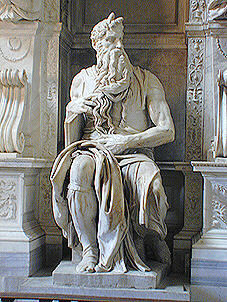
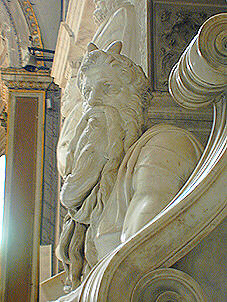
Moses statue was completed in 1515, two years after the death of Pope Julius II, and the work on the funerary monument was ended in 1545, reaching only a part of the original project ("a tragedy",
as Michelangelo put it). Nevertheless, Michelangelo was so
impressed of the result of his work that it is said he threw
his hammer against the statue crying "Why won't you speak?".
Sigmund Freud, who was very interested in the symbological meaning of the figure of Moses, and in general in anthropology and psychology of
the religions, came to Rome in more than one occasion to study
and to interpret the statue. |
Pope Julius II summoned Michelangelo
in 1505 to build a sumptuous mausoleum for himself and for his family, which
would have included 47 statues. The work was suspended many
times, first because of disputes between the Pope and Michelangelo,
then because the artist had to decorate the Sistine Chapel,
and finally because of the death of the Pope.
The master entrusted
the main part of the work to his pupils, who executed them
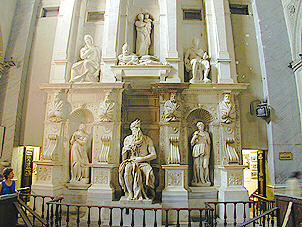
in accordance to his designs. Michelangelo was though to be entirely the author of the statue of Moses, and was largely the author of
the figures next to him, patriarch Jacob's wives Rachel (left, symbolizing
Contemplative Life), and Leah (right, Active Life).
|
The complex of statues
of Michelangelo
|
|
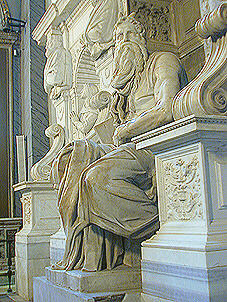 |
Moses, side view |
|
S. Freud believed that Moses was an Egyptian, not a Jew. According to the
founder of psychoanalysis, he was a priest, a follower of the religion
worshipping the sun, introduced by Akhenaton. When the traditional
priests restored the original Egyptian religion, they persecuted
the followers of Akhenaton. Moses
then sought protection among the Jews, originally an Egyptian tribe.
According to Freud, the Jews were thus converted to the new religion, and later developed
their present one.
Freud tried also to interpret the particular posture that Michelangelo
gave to Moses. In fact he does not have a classical expression,
but rather a grim look to the left. Freud wrote an essay about his
thoughts, entitled "The Moses of Michelangelo". |
|
He concluded that Moses has the very serious and grim expression
as he just returned from the mountain where he received the Tables
of the Law, and he found his people worshipping the Golden Calf.
Moses is hence looking at them in disdain, and is about to stand
up and break the Tables of the Law in anger.
|
|
|
|
|
The Church of San Francesco di Paola |
As mentioned, the church also preserves the chains of St. Peter,
in the confessio. According to tradition, when the two chains used
to fetter the Saint in Jerusalem and in Rome were brought together,
they were united miraculously.
Adjacent to the church of St. Peter's in Chain, and having its entrance
in the same square, is the national church of the Calabrians, named after the saint San
Francesco di Paola. The medieval tower of the Margini was converted
into its bell tower.
Back to the "Monti quarter general
presentation"

Visit Rome | Rome panoramic views | Rome apartments and villas | Inquire | Rome travel guide | Rome map | Service | Resources
Roman Homes homepage |