Rome gelato, Cafes,
ice cream parlors, confectionery shops
Gelaterie, or ice cream parlors
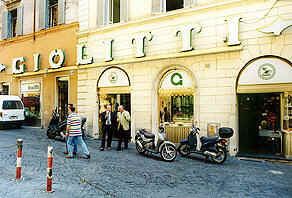
Most Romans consider Giolitti in Via Uffici
del Vicario 40 the best ice cream cafe' in town. Surely
the place is very popular ("an institution"
as we say in Rome), yet other places today appear trendier.
Il Gelato di San Crispino (Via Della Panetteria 54, near
the Trevi Fountain, tel. 0670450412 - closed Tuesday)
is today considered by most the best gelateria in Rome
(some say of Italy). Flavors are perfectly balanced, and
the ice cream superlative. It was founded by two brothers
who studied in Florence, and who were inspired by Vivoli.
Their philosophy is to have a specific preparation for
every flavour (some invented by them), with maniacal attention
to quality. Their renowned flavours are Pistachio, Chocolate
with liqueur, and Zabaione made with natural eggs and
20 years old Marsala. Only tubs, as "cones interfere
with the flavour". |
|
Giolitti: two signori (gentlemen)
stepping
out with their gelato (ice cream).
|
|
We also e recommend Fonte
della Salute (the Fountain of Health, in Via Cardinal Marmagi 2,
tel. 065897471).
Another fine parlor is Fiocco
di Neve (Snow Flake, in Via del Pantheon 51, no phone).
We also recommend Gelatone, in the Monti quarter
(Via dei Serpenti 28, tel. 064820187). Chef Paolo prepares
about 100 flavours, including some he creates (for
ex. "Crema Antica" - Ancient Cream).
If you like granite (ice cream slush), and particularly granita di caffe' (coffee ice cream slush), we recommend Cremeria Ottaviani (Via Leone IV 83/85, tel. 0637514774). |
|
Pasticcerie, or confectionery shops
There are many pastry shops in Rome, but
few prepare excellent regional desserts. A good one
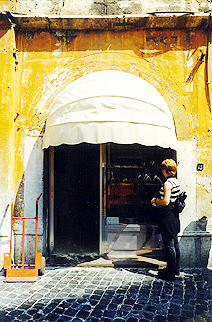
is the Forno del Ghetto (the Ghetto's Baker, in Via
del Portico d'Ottavia 20/b, tel. 06687637, closed on
Friday after sundown, Saturday and on Jewish holidays.
It is a tabby little place, literally a hole-in-the-wall,
with women only personnel and no sign outside, preparing delicious Jewish take-away
pastries made of
a combination of candied fruit, raisins and marzipan (they are called Pizza Ebraica although they are sweet).
They also prepare memorable ricotta
cakes (with sour
cherry jam or chocolate).
Traditional Roman cakes include Mostaccioli,
Panpepato and Pangiallo, made with dried fruit, nuts and honey.
In the same street, just before the Portico (porch)
of Ottavia , you will find Dolceroma (Sweet Rome,
tel. 066892196), a classical pastry shop, with excellent
Sacker Tort, and - surprise - American pies.
For more details, please visit the page of the Roman quarter or Ghetto.
|
|
Caffe', or Cafes
In Rome, like elsewhere in Italy, you find cafe'-bars and cafes in any corner. The quality of coffee is usually very high, and what varies is the elegance of the cafe'-bar, its charm, and also the way customers are allowed to have beverages. Italians in fact usually have a quick coffee at the counter, while sitting and having drinks at the table is consistently more expensive, and it is possible only in quality cafe'-bars.
In Italian coffee is written caffe' and it is pronounced with stress on the last vowel (pron. Cahffaeh, don't forget the accent at the end, and the Italians will thus be impressed!).
The Italian coffee terms you always wondered about
First of all the Italians make a difference between Espresso (prepared at the bar with specific machines) or Moka (prepared at home with specific coffee pots, called "caffettiere").
The "philosophy" of the Italian coffee is that water under
high pressure should pass as fast as possible the coffee powder,
thus the name espresso (express coffee). It is intensely
aromatic, and very strong, and the Italians usually like
it very concentrated (in this case it is called "caffe'
ristretto",
or simply "ristretto"). If you want it more diluted,
and hence with coffee filling the small cup up to the edge,
ask for "caffe' lungo" (long). To most non-Italians, this is still too little, as it barely fills the small espresso cup.
If you are American,
we thus recommend that you ask for "Caffe' Americano":
the barman will put the normal Italian coffee in a larger
cappuccino cup, and dilute it with hot water. If you want
some liqueur, then ask for "caffe' corretto" (literally
revised coffee). Finally ask for "caffe' macchiato" (lit. stained coffee), if you want instead an additional splash
of milk.
Of course then you know about cappuccino. Perhaps you don't
know though that the name originates by its colour, which is the same of the habit of the Capuchin monks. As you know,
it looks like a frothy white coffee. In fact, to prepare
it with the espresso machine some steam is pumped into some
milk, and then a normal espresso coffee is added. Some Italians
add some cocoa powder on the surface, and in this case it is usually called "Mokaccino" (there are also other jargon terms for it, changing to place to place).
The cappuccino must not be confused with caffellatte (milk
and coffee, in which a generous quantity of hot milk is
added to a normal espresso, without steam), and with latte
macchiato (milk with a splash of previously prepared, cold
coffee).
What about American coffee in Rome and in Italy?
American coffee doesn't exist practically in Italy. It is not only a matter of shortage of American coffee supply or of percolators. The sheer fact is that for Italians American coffee is taboo. Italians are very open-minded for all and for everything, but not for three things: coffee, pasta, and pizza. American coffee is not acknowledged as real coffee by Italians. They consider it something strange, quasi-coffee, with a somewhat childish taste, and for them practically undrinkable, or not even coffee.
In Rome you can purchase it however in one specialized shop near the Vatican. The shop is called Castroni, in Via Cola di Rienzo (click on the link to go to the page presenting it).
We recommend that you use the normal Italian coffee in American coffee percolators (supposing you find one - they are difficult to find for the same reasons of coffee). When in Rome...
In bars, you might ask for "Caffe' Americano" which doesn't mean they'll give you an American coffee (which as mentioned is just taboo) but an espresso in a cappuccino cup, diluted with hot water at leisure (and they will look at you as if this were strange).
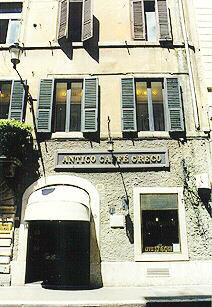
The most famous cafe'-bar in Rome is the Antico Caffe' Greco (Via dei Condotti 86, tel. 066791700),
one of the three most ancient cafes in the world, with
a very classical atmosphere, red-velvet chairs and marble
tables. It hosted the likes of Byron, Shelley, Keats,
Goethe, and Casanova. It is quite expensive, and a coffee
or a glass of soda will cost you 5 Euro appr. 6 US$.
Rome's trendiest cafe and tearoom is perhaps though the Rosati (Piazza del Popolo 5, tel. 063225859), including
also a dining room upstairs. Rosati never went out of
style, and is a rendezvous of literati, artist, actors,
and film directors. Another cafe'-bar attended by the
literati is the Sant'Eustachio (Piazza Sant'Eustachio
82, tel. 06861309).
Romans say the best coffee is prepared though at the Tazza
d'Oro (Golden cup, in Via degli Orfani, near the Pantheon,
tel. 065835869).
|
|
Back to Rome guide

Visit Rome | Rome panoramic views | Rome apartments and villas | Inquire | Rome travel guide | Rome map | Service | Resources
Roman Homes homepage |